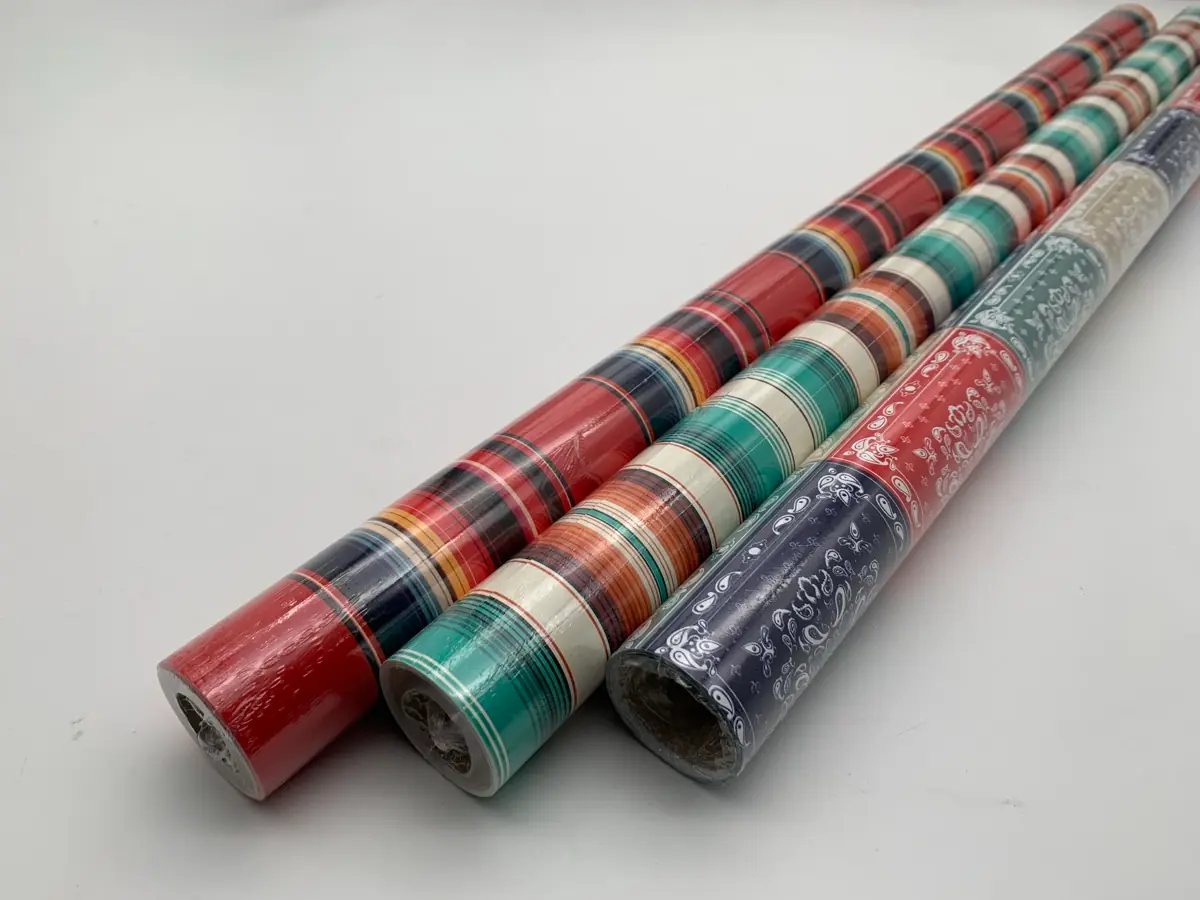
Wholesale Tissue Paper: A Smart Choice for Retail and Packaging Businesses
Buying at wholesale volume is one of the few decisions in tissue paper where the price per unit can move by more than half without the paper changing at all - what changes is the order shape around it. A distributor buying by the pallet, a retail chain standardising ten store formats and a subscription brand ordering twice a season are all buying the same substrate on very different terms. This guide looks at what actually drives a wholesale price, where custom printing starts to earn its keep, and how to plan stock so that a good rate does not turn into dead inventory.
TL;DR
Lower your unit cost by buying weight rather than pieces, and buy at the bottom of a tier instead of a little above it. Below roughly 250 to 500 kg per design, custom printing is priced by print set-up rather than by paper, so plain stock plus a label usually wins; above that, flexo-printed tissue normally costs less per sheet than buying plain and printing locally. Sampling runs 5-7 working days and bulk production 10-15 working days after proof approval, freight separate.
What Wholesale Actually Means in Tissue Paper
Tissue is traded by weight, which makes wholesale a different idea than it is in most packaging categories. A wholesale price is quoted against kilograms, and the piece count you receive depends on two things you specify separately: grammage and format. A 250 kg order at 17 gsm in a 50 x 70 cm sheet is roughly twice as many sheets as the same weight at 35 gsm. Until the units are agreed, two quotations that look 20% apart may not be comparable at all.
That is why the first question on a wholesale enquiry should be about the unit rather than the price. Suppliers quote per kilogram, per ream of 500 sheets, per pack of 100 or per roll, and those four are not interchangeable. Why custom tissue paper has a minimum order quantity explains the factory side of the same arithmetic, which is useful background even if you only ever buy finished stock.
How Wholesale Pricing Steps With Volume
Wholesale prices do not fall smoothly, they step. Each step corresponds to a fixed cost being absorbed: a printing plate, a conversion set-up, a full pallet, a full container. Recognising where the steps sit lets you buy at the bottom of a tier rather than slightly above the top of the one below - which is the difference between paying for a tier and merely qualifying for it.
Two rules follow. First, check whether a tier applies per design or to the combined weight of your order. The difference matters most when you carry several colourways: if the tier is measured on combined weight, consolidating four designs into one commitment takes you down a step that four separate orders never reach.
Second, price the whole programme rather than the first order. A rate that saves a few per cent per kilogram but leaves you holding eleven months of tissue paper is not a saving, it is a warehouse cost with a paper smell. The two failure modes - buying too little and buying too much - have different costs, and only one of them is reversible.
Order shape
Typical scale
What changes at this tier
Best suited to
Carton or single pack
A few kilograms per SKU
Stockist pricing, no print set-up available
Test trading, single-store retail
Loose wholesale
Roughly 250-500 kg per design
Print set-up starts to amortise; plates charged once
Independent retail, first printed run
Pallet programme
1,000 kg and above per design
Conversion set-up and packing format become standard; per-kilogram price steps down
Multi-store retail, regional distributors
Container programme
Several tonnes, often across designs
Freight becomes the dominant fixed cost; combining SKUs lowers the landed rate
National distributors, seasonal programmes
Plain Stock or Custom Print: Where the Break-Even Sits
Plain tissue is a commodity and competes almost entirely on price and availability. Printed tissue competes on brand, and it carries a fixed cost that plain stock does not: plates or cylinders, an ink match, and make-ready spoilage. In practice the crossover usually sits around the 250-500 kg mark per design. Below it, buying plain tissue and adding a printed label or sticker is cheaper. Above it, flexo-printed tissue is normally the lower-cost route per sheet.
The decision is not only financial. Printed tissue changes how a customer experiences the unboxing and how consistently your brand appears across stores, which is why retail chains standardise on printed stock even where plain would be cheaper. What custom printed tissue paper does for a brand covers that side of the argument, and tissue for ecommerce order volumes works through the same trade-off for pick-and-pack operations.
Format and Packing: The Cost Per Sheet You Actually Use
Two buyers can pay the same price per kilogram and end up with very different costs per delivered sheet. Format is usually the reason. A sheet cut to the size your packers actually use wastes nothing; a sheet that is 10 cm too wide on two sides wastes close to a fifth of the paper, or forces staff to tear it by hand at the bench. Roll formats suit high-volume wrapping stations, while pre-cut sheets suit pick-and-pack benches where speed matters more than material efficiency. The same logic applies when a programme pairs tissue with gift wrapping paper or grease proof paper.
Confirm sheet size in millimetres against the pack you are wrapping, not against a catalogue name
Ask whether the price includes the inner bag or carton, since a loose pack needs its own protection
Check pieces per carton and cartons per pallet - both feed the landed cost per sheet
For rolls, confirm core diameter and roll length, because they decide whether your dispenser works
Supply Stability Across a Retail Season
Tissue is a low-value, high-volume line, which makes a stockout disproportionately expensive: the paper is cheap, but a pack that cannot be finished on time costs you the order. Plan reorders on consumption rather than on the calendar. Measure how many kilograms the busiest four weeks genuinely consume, hold enough to cover transit plus one reorder cycle, and place the seasonal commitment early enough that a delayed vessel does not land in the middle of your peak.
Two operational facts matter more than any forecast. Chinese New Year closes production for a period each year, so an order placed in the weeks before it will queue; and ocean transit is separate from production time, so the real clock starts at artwork approval rather than at the purchase order. Planning peak seasons without shortages sets out the timing in more detail, and selecting a tissue manufacturer covers what to look for before you commit to a supplier.
The Paperwork a Distributor Picks Up
Wholesale buyers take on obligations that a single-store retailer does not, because they pass product on. Three documents cover most of it: the supplier's FSC chain-of-custody certificate in the supplier's own legal name (ours is ESTS-COC-200766), a food-contact declaration wherever the tissue meets food, and the EU Declaration of Conformity for any pack sold into the EU, where PPWR core obligations have applied since 12 August 2026. Our PPWR buyer's guide sets out what the declaration has to state.
FSC chain-of-custody certificate with the number, issued in the supplier's own name
Food-contact declaration for any tissue used in direct contact with food
EU Declaration of Conformity under PPWR for EU-bound packaging, retained for five years
If you pass an FSC claim to your own customers, confirm your own position with your certification body first
Buying From a Mill or From a Trader
A trader is not automatically the wrong choice. They can be the right one when you need small mixed quantities, several substrates at once, or local stock at short notice - and a good trader adds real value in market knowledge. What a trader cannot usually give you is control over the specification, the print quality or the compliance file, because all three sit upstream. Buying direct gives you the mill's chain of custody, its quality system and a named technical contact, in exchange for minimum quantities and a longer calendar.
Ask both the same four questions and the difference becomes visible quickly: who owns the certificate, who owns the print set-up, who is accountable if the colour is wrong, and what happens to your plates if you change supplier. A programme that also carries white kraft paper or another paper line is worth asking about in the same conversation, because a combined programme usually prices better than two separate ones.
Setting Up a First Wholesale Order
Send one message rather than five: format in millimetres, grammage bracket, print requirement (none, one side, both sides, colour count), number of designs, realistic annual volume, and the destination market. That is enough for a supplier to quote a real per-kilogram price instead of a range. How to write an RFQ for custom packaging paper shows the format in full. Sampling runs in 5-7 working days and bulk production in 10-15 working days after proof approval, with freight quoted separately, so the artwork date is the true start of the calendar. Send the details to sales@wiseinco.com and we will come back with a tier table for your volumes. The buying patterns described here are composite industry scenarios rather than specific client engagements.
Frequently Asked Questions
What counts as a wholesale order in tissue paper?
There is no single threshold, because wholesale pricing is weight-based. A carton is a stockist purchase; from roughly 250 to 500 kg per design you are in loose wholesale territory where print set-up starts to amortise, and at 1,000 kg per design and above you are into pallet or container programmes where the per-kilogram price steps down again.
Is plain tissue cheaper than custom-printed tissue?
Below roughly 250 to 500 kg per design, yes - the plate or cylinder cost is spread over too few pieces. Above that level flexo-printed tissue is normally the lower-cost route per sheet, and if you need several colourways it is worth asking whether minimums can be met on combined weight rather than per design.
How should I compare two wholesale tissue quotations?
Compare the unit first. One quote may be per kilogram and the other per ream, per pack or per roll, and a ream says nothing about weight until you know the gsm and the sheet size. Once the unit matches, compare grammage, sheet size, whether inner packing is included, and the incoterm before you compare the headline number.
How much stock should I hold between reorders?
Base it on consumption rather than on the calendar. Measure what your busiest four weeks actually consume, then hold enough to cover the transit leg plus one reorder cycle. Tissue is low-value but bulky, so over-ordering is a storage problem while under-ordering is an order-fulfilment problem.
Can I sell imported tissue paper in the EU?
Yes, but the compliance file travels with the product. For EU-bound packaging you should be able to obtain the EU Declaration of Conformity from your supplier, since PPWR core obligations have applied since 12 August 2026, plus a chain-of-custody certificate for any FSC claim and a food-contact declaration where the tissue touches food directly.
What lead time should I plan for on a wholesale tissue order?
Sampling runs in 5-7 working days from artwork approval, and bulk production runs in 10-15 working days after the proof is signed off. Freight is quoted separately and sits on top, so if you are importing, the artwork approval date - not the purchase order date - is the start of the calendar you should plan against.
Need custom tissue paper?
From acid-free archival to printed unboxing tissue — tell us your use case and we’ll match a grade.
Sales Manager at WiseInco · 15+ years in packaging paper industry
Helping global brands source FSC-certified gift wrapping, tissue, kraft, and greaseproof paper from our 50,000 m² factory in Dongguan, China. 5,000+ containers exported to 30+ countries annually.