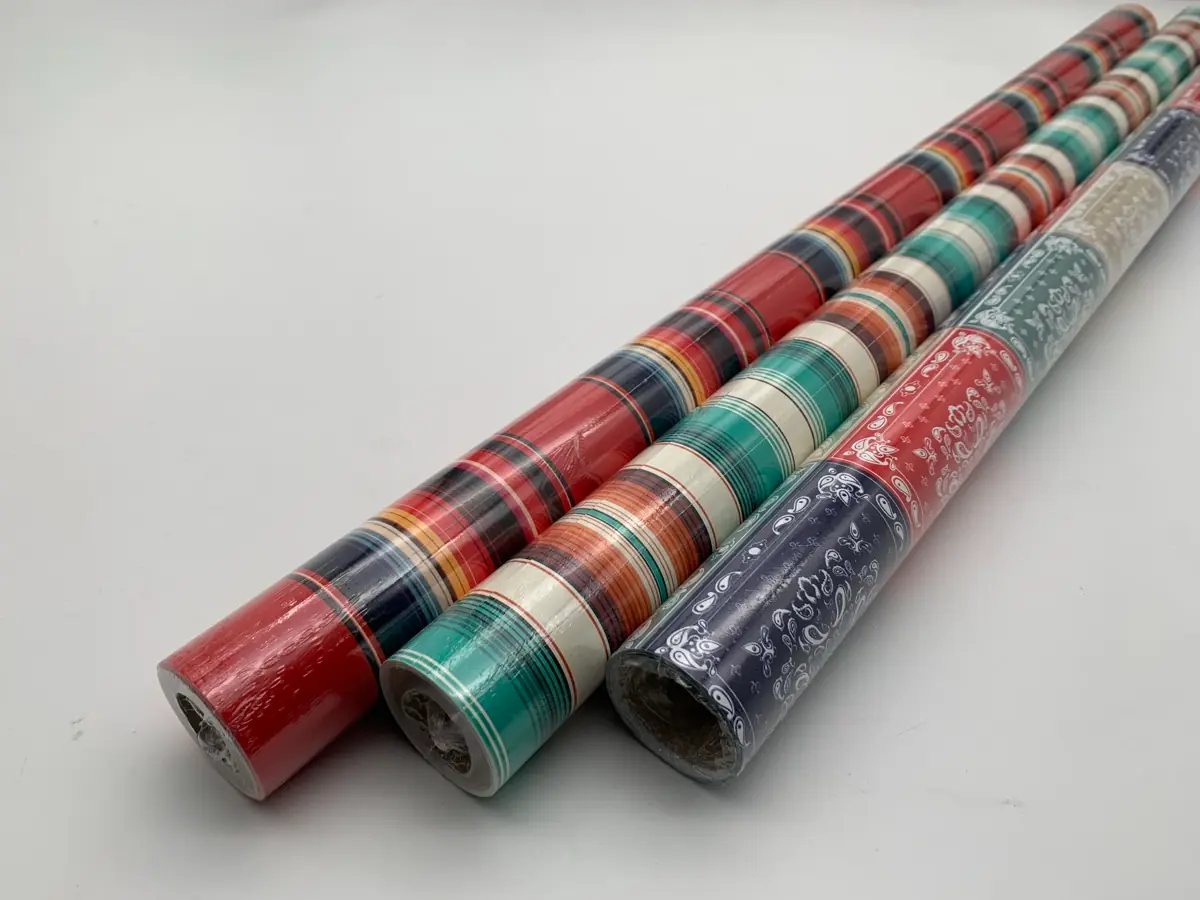
Sourcing Gift Wrapping Paper in the UK: A Practical Buyer's Guide
A UK buyer looking for gift wrapping paper usually has two serious options on the table: a domestic stockist who can ship within days, or a manufacturer who will print to your artwork and ship direct. Both are legitimate, and the right answer depends on your volume, your design ambitions and how much import administration you want to own. This guide sets out the practical differences - minimum order quantities, lead times, the UK duty and VAT position, and the pEPR questions UK brands are asking right now.
TL;DR
For most UK programmes above roughly 500 reams per design, importing direct from a manufacturer costs less per unit than buying from a UK stockist, and it is the only route that unlocks full custom printing. Budget five to seven days for sampling, ten to fifteen days for bulk after proof approval, then ocean transit on top. Paper and paperboard mostly enters the UK at 0% duty with 20% import VAT, and large producers also pay packaging waste disposal fees of roughly GBP 190 to 250 per tonne depending on recyclability.
UK Stockist or Direct Import: What Is Really Being Compared
A UK stockist holds inventory and sells it in small quantities on short delivery windows. You get speed and no customs paperwork, and for a boutique taking a few hundred reams a quarter that is genuinely good value. What you give up is design control: a stockist range is fixed, and print is usually limited to whatever is already in the catalogue. If your brand identity depends on a specific wrap, the stockist route is a compromise from day one. Our wholesale wrapping paper sourcing guide covers the same fork in the road from the manufacturer's side.
A manufacturer sells from the production line. You commission the artwork, choose the grammage and the sheet size, and the paper is printed for your order. Unit cost falls as volume rises because you are no longer paying for someone else's warehouse and margin. In exchange you take on minimum quantities, a longer calendar and the import formalities. Neither route is wrong - they solve different problems, and plenty of UK brands use both.
The Two Routes Side by Side
The table below sets out the practical differences a UK buyer weighs up. Treat it as a starting frame rather than a rule: your volumes, artwork and seasonality will shift several lines in one direction. If you are still at the stage of shortlisting factories, how packaging buyers compare suppliers sets out the criteria that actually separate them.
Decision point
UK stockist
Direct import from a manufacturer
Minimum order
Often a single carton or pack
Custom print typically starts around 500-1,000 reams per design
Unit cost at scale
Higher - stockist margin and UK warehousing are built in
Lower - mill pricing with no intermediary layer
Design freedom
Limited to the stockist range
Full: artwork, Pantone colour, grammage, sheet size, packing format
Time to first delivery
Days
Sampling 5-7 days; bulk 10-15 days after proof approval; transit on top
Import administration
None - the stockist is the importer
You are the importer of record: duty, VAT and pEPR reporting apply
Best suited to
Urgent top-ups, market tests, very small runs
Programme volumes and any requirement for custom printing
Lead Times: Three Separate Clocks
Lead time is where first-time UK importers most often get caught, usually because three separate clocks are treated as one. Sampling runs first: five to seven days from artwork approval to a physical pre-production sheet in your hands. Bulk production runs second: ten to fifteen days after you sign off the proof. Transit runs third, and it is entirely separate from production - ocean freight from South China to Felixstowe or Southampton is typically thirty to forty days port to port, before clearance and inland haulage.
Added together, a direct import normally lands about forty-five to sixty days after artwork approval. Air freight compresses the transit leg to a few days at a far higher cost per kilogram, which rarely makes sense for a full seasonal run. The honest consequence is a calendar problem rather than a factory problem: brands that approve Q4 artwork in September are not waiting on a press, they are waiting on the ocean. If your seasonal planning is still loose, how far in advance to order custom packaging paper breaks the calendar down by month.
Sampling: 5-7 days from artwork approval to pre-production sheet
Bulk production: 10-15 days after proof approval
Ocean transit: roughly 30-40 days port to port, then clearance and inland haulage
Duty, VAT and the UK Compliance Layer
Importing makes you the importer of record, which is the single biggest practical difference between the two routes. Duty is set per ten-digit commodity code rather than per chapter: HMRC's UK Trade Tariff lists heading 4819 - cartons, boxes, bags and other paper packing containers - at 0.00% third country duty across all of its commodity codes, and heading 4821 for paper labels likewise. Confirm the code that matches your exact product and format before you build a landed-cost model, because classification depends on the article, not the material. Import VAT is charged at 20% on the customs value plus any duty.
If your business is VAT registered, Postponed VAT Accounting lets you account for import VAT on your VAT return instead of paying it at the port, which for most companies is a cash-flow-neutral position rather than a cost. If you are not VAT registered it is a real upfront cost and belongs in the budget from the start. On the packaging side, two UK schemes are worth separating because only one of them typically applies to paper.
Cost or obligation
Typical position
Who handles it
Import duty (UK Global Tariff)
0.00% on heading 4819 packing containers and heading 4821 labels; confirm the ten-digit code
You, via your customs broker or forwarder
Import VAT
20% on customs value plus duty
You - or postponed via PVA on your VAT return
pEPR waste disposal fee
Large producers only; paper and board illustrative Year 2 rates GBP 190 (green) / 210 (amber) / 250 (red) per tonne
The UK brand owner or importer of record
Plastic Packaging Tax
GBP 228.82 per tonne from 1 April 2026, on plastic components with under 30% recycled content
Only where the pack contains in-scope plastic
Why Foil, Glitter and Lamination Now Cost More
Under UK packaging extended producer responsibility, fees are no longer flat. PackUK grades each packaging unit through its Recyclability Assessment Methodology and assigns a green, amber or red rating. For Year 2 the red rate is set at 1.2 times the amber rate, rising to 1.6 times in Year 3 and twice the amber rate in Year 4 - and the illustrative Year 2 rates for paper and board published by Defra and PackUK are GBP 190 green, GBP 210 amber and GBP 250 red per tonne. Paper and board is a favourable material in this framework, but the rating is assessed on the whole construction rather than on the substrate alone.
For gift wrap that matters because decoration is exactly what fails a recycling assessment. Metallic foil blocking, loose glitter, heavy lamination and carbon-black inks all make a sheet harder to sort or repulp. A printed sheet on certified paper with a moderate ink laydown will usually sit in the green or amber band; the same sheet under a full metallic surface will not. This is an argument for knowing which part of your range carries them, and for sizing the fee before you commit rather than afterwards. Is wrapping paper recyclable? looks at the same question from the household bin backwards, and if you want a decoration-free alternative the sheet itself is the starting point: white kraft paper takes print and foil-free finishes well.
Green rating: widely recyclable in practice, roughly 9% below the amber rate in Year 2
Amber rating: the base rate, conditionally recyclable with barriers at one or more stages
Red rating: 1.2x the amber rate in Year 2, rising to 1.6x in Year 3 and 2x in Year 4
How to Vet a Manufacturer Before You Commit
The questions that separate a real export factory from a trading desk are boring and specific, and they are the questions worth asking before price. Chain of custody should be held in the manufacturer's own legal name - ours is ESTS-COC-200766 - rather than described as a reference to a third party's licence. Ask who owns quality control, what the sampling protocol is, and how the approved proof is recorded so that it becomes the contract rather than a photograph in an email thread. Our how to choose a reliable wrapping paper supplier checklist runs through the same questions in more depth.
FSC chain-of-custody certificate in the manufacturer's own name, plus the certificate number
ISO 9000 quality system documentation and a named QC owner
Ink and coating safety documentation if the wrap will touch food or cosmetics
A written sampling protocol and a proof approval step with recorded artwork references
Running a Hybrid Programme
Very few UK brands pick one route and stay there. The pattern that works best is to import the seasonal volume, where the per-unit saving is largest and the calendar is predictable, and keep a domestic source for emergency top-ups, single-carton orders and last-minute retail requests that will not wait for a vessel. The two routes then stop competing and start covering for each other.
That split also solves the two problems a single source cannot. Direct import gives you the design control and unit economics of a mill, while a UK stockist gives you a shelf that is already full when a customer asks for two cartons on Thursday. Brands that also run tissue paper or white kraft paper can usually consolidate both lines into one import programme, which improves container fill and spreads the fixed cost of freight across more of the order.
Whichever mix you choose, put the compliance calendar on the same wall as the production calendar. pEPR reporting is driven by packaging weight by material, so you need clean data on how much paper you placed on the market; and the artwork deadline is the real start of the project, not the purchase order. Brands that manage those three dates together rarely run out of wrap in December. The sourcing patterns described in this guide are composite industry scenarios rather than specific client engagements.
Frequently Asked Questions
What is the minimum order for custom printed gift wrap into the UK?
Most manufacturers set a custom print minimum somewhere around 500 to 1,000 reams per design, because each design carries its own print set-up. Plain, unprinted paper can usually start lower. If you are testing a design, ask for a pre-production sample before committing to the full run, and ask whether several designs can be combined into one commitment.
How long does it take from artwork approval to delivery in the UK?
Sampling takes five to seven days. Bulk production takes ten to fifteen days after proof approval. Ocean transit to Felixstowe or Southampton is typically thirty to forty days port to port, with clearance and inland haulage on top - so a realistic door-to-door window is around forty-five to sixty days from artwork approval. Air freight shortens the transit leg to days at a much higher cost.
Do I pay duty and VAT on imported gift wrapping paper?
Duty is set per ten-digit commodity code, so check yours before costing the order. HMRC's UK Trade Tariff lists heading 4819 - cartons, boxes, bags and other paper packing containers - at 0.00% third country duty across its commodity codes, and heading 4821 for paper labels likewise. Import VAT is 20% on the customs value plus duty. VAT-registered businesses can use Postponed VAT Accounting to declare it on a VAT return instead of paying at the port.
Does UK packaging EPR apply to gift wrapping paper?
It can. Businesses with turnover above GBP 2 million that handle more than 50 tonnes of packaging a year are large producers and must register, report packaging data every six months, buy PRNs and pay a waste disposal fee. Illustrative year-2 paper and board rates run from about GBP 190 per tonne for a green recyclability rating to about GBP 250 for a red one.
Is FSC-certified paper available for UK-bound orders?
Yes. Reputable manufacturers supply paper under their own FSC chain-of-custody certificate rather than borrowing someone else's. Ask for the certificate and its number in writing before you order, and confirm that the certificate covers both the paper and the printing operation.
Which incoterm should a first UK order use?
FOB, CIF and DDP are the three that come up most often. FOB gives you the most visibility of your own freight cost, CIF is a middle ground, and DDP minimises your administration because the supplier manages freight and duties. DDP is convenient but bundles the landed cost, so ask for the breakdown if you need to compare suppliers properly.
Need custom gift wrapping paper?
Compare finishes, weights, and printing options across our full gift wrap range.
Sales Manager at WiseInco · 15+ years in packaging paper industry
Helping global brands source FSC-certified gift wrapping, tissue, kraft, and greaseproof paper from our 50,000 m² factory in Dongguan, China. 5,000+ containers exported to 30+ countries annually.